48 hours in Macau — a realistic two-day plan
Two days in Macau is enough time to see the historic peninsula properly, eat your way through Taipa Village, experience the spectacle of Cotai, and still catch the last ferry back to Hong Kong without feeling robbed of a night’s sleep. This is the plan that works — not the optimistic blog-post version, but the one that accounts for ferry queues, midday heat, and the fact that you will inevitably stop for 40 minutes at a random tile shop.
The full two-day itinerary on this site gives a more structured version. This post adds the editorial commentary: what’s worth the time, what to skip, and what those 48 hours actually feel like.
| Where | Macau Peninsula (day one), Taipa Village & Cotai (day two) |
| Cost | around MOP 600–2,500 / USD 75–312 per day, excl. accommodation |
| Getting there | ferry from Hong Kong, around 60 minutes |
| Pace | brisk but not rushed — one heritage site or neighbourhood per half-day block |
| Best for | first- or second-time visitors who want peninsula, Taipa and Cotai in one trip |
Day one: the peninsula
Morning — the heritage loop
Start at Senado Square before 9am. It sounds early, but the square is significantly more pleasant before the tour groups arrive around 10am. The black-and-white wave mosaic is a legitimately beautiful piece of Portuguese-derived tilework, and the colonial buildings along the northern edge — including the Leal Senado building (Civic Centre), which dates to 1784 — are best photographed in morning light before the crowds fill the frame.
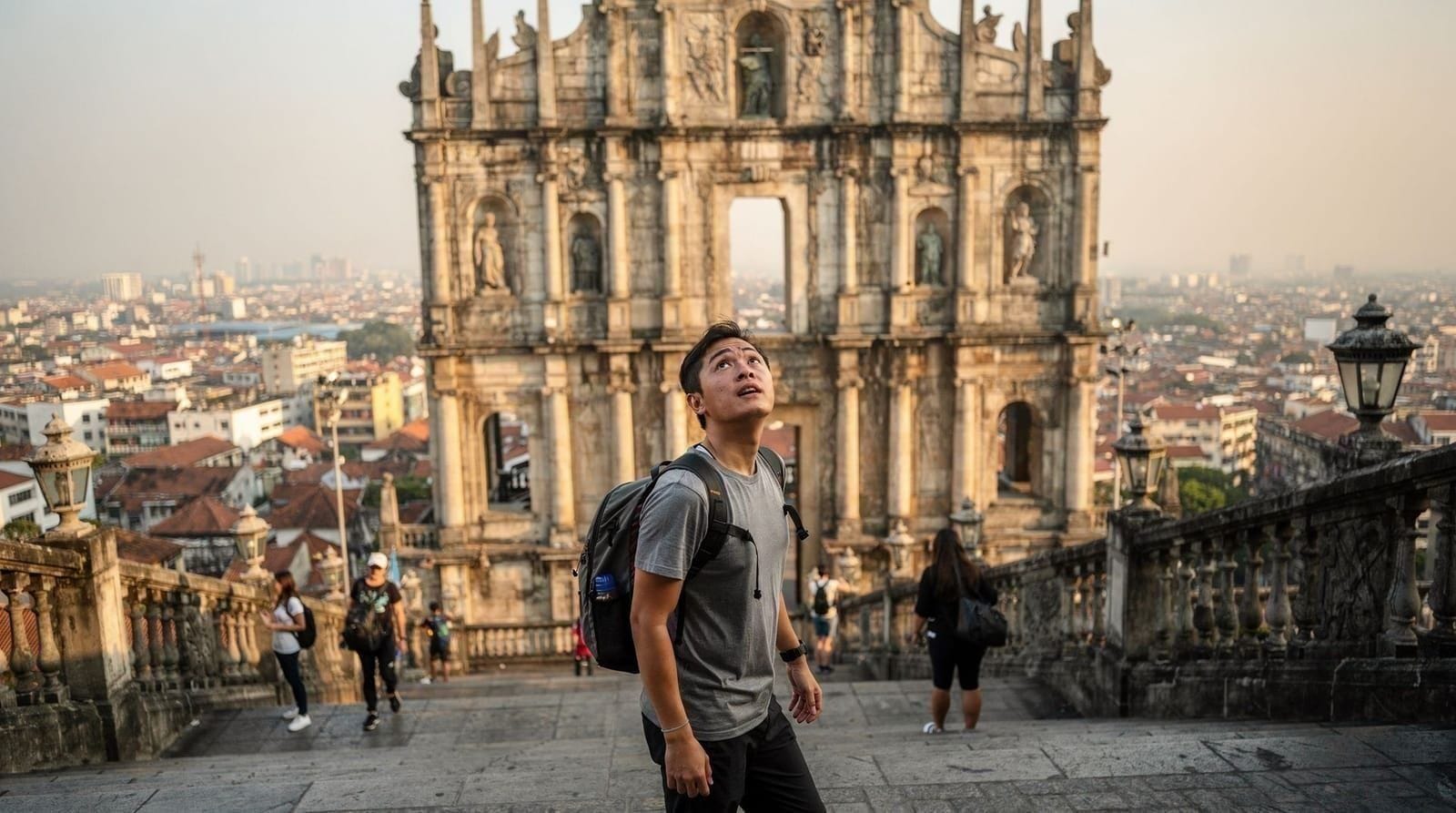
From Senado Square, walk northeast through the Old Protestant Cemetery and up to the Ruins of St. Paul’s. The ruins are the most photographed sight in Macau: the ornate stone facade of a 17th-century Jesuit church that burned to the ground in 1835. The facade is genuinely impressive and the carvings — mixing Christian iconography with East Asian motifs — are worth reading closely. The crypt beneath contains the remains of Japanese Christian martyrs executed in the early 17th century.
From St. Paul’s, climb the hill to Mount Fortress. The Macau Museum inside (MOP 15 / USD 1.90 adults, free on the 15th of each month) is one of the better small-city museums in Asia, covering the territory’s history from pre-Portuguese times through the handover. Allow 45 minutes. The views from the fortress walls across the peninsula are the best free panoramic vantage point in Macau.
Late morning — Guia and down to lunch
If your legs are willing, walk or take a taxi to Guia Fortress. The lighthouse (built 1865) is the oldest on the South China coast, and the chapel inside contains a remarkable set of 17th-century frescoes that fuse European and Chinese painting styles. Free entry. The surrounding Guia Hill park is a good spot to decompress if the city is getting loud.
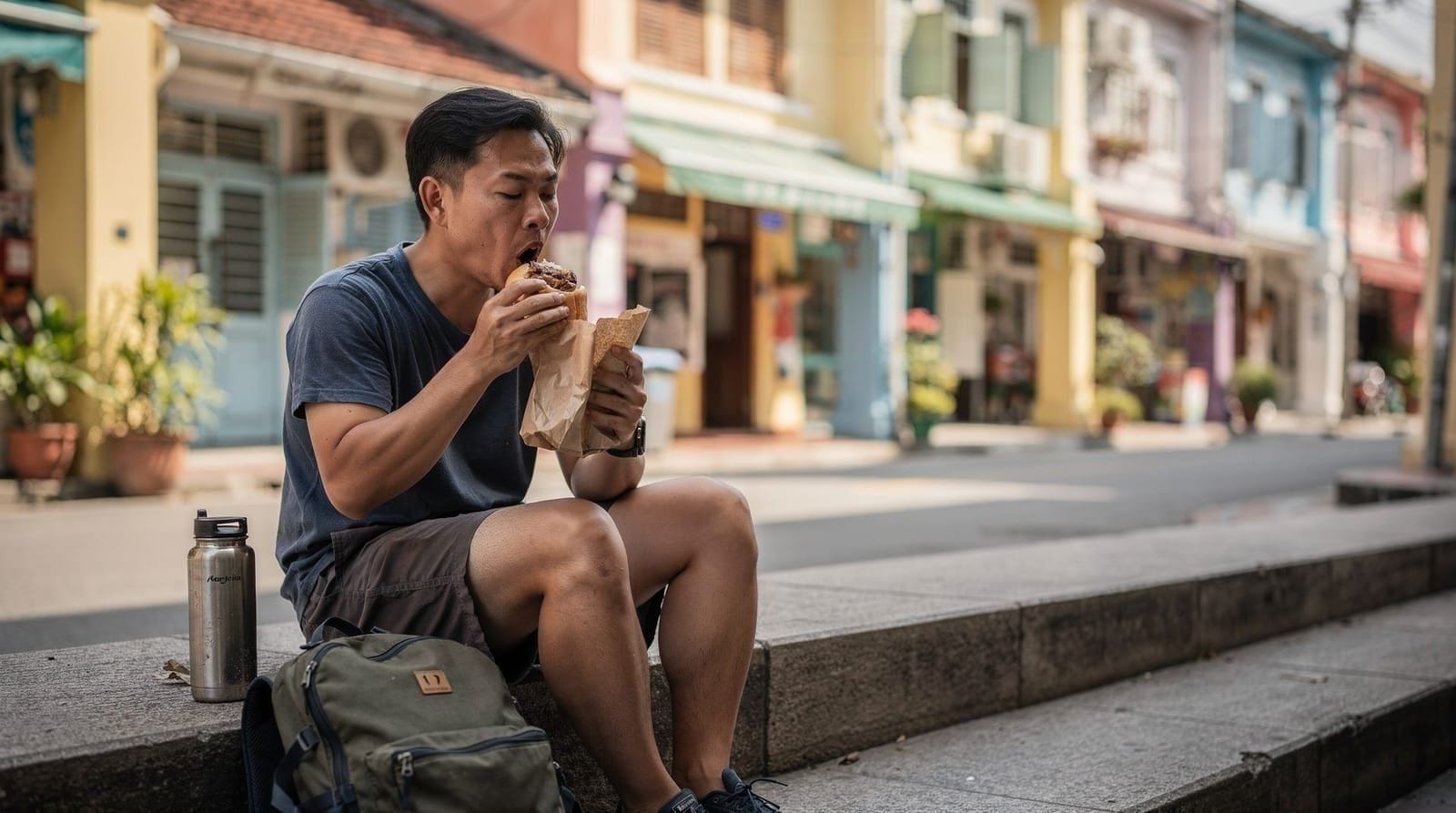
Lunch back on the peninsula: Wong Chi Kei at Senado Square is the obvious tourist choice, but their wonton noodles are genuinely good and inexpensive (MOP 35–55 / USD 4.35–6.85). If you want something more atmospheric, walk to one of the old-school pastelarias near the ferry terminal for a pork chop bun (MOP 22–30 / USD 2.75–3.75) and Vietnamese coffee.
Afternoon — A-Ma Temple and the Inner Harbour
After lunch, head south to A-Ma Temple, one of the oldest in Macau. The complex dates to at least 1488 — pre-dating Portuguese arrival — and is dedicated to the sea goddess Mazu. It’s active, incense-heavy, and authentically used by local worshippers rather than staged for tourists. Free entry. The Inner Harbour area nearby has some of the most photogenic street-level architecture on the peninsula — faded Portuguese-style townhouses, fishing boats, dried seafood shops — and has been significantly less photographed than the Ruins area.
If the Macau Tower is on your list, this is the afternoon to go. It’s a short taxi ride from A-Ma Temple. The observation deck costs MOP 145 (USD 18) for adults, with reduced rates if you book online. The bungee jump and SkyWalk are the famous extreme options — the bungee at 233 metres is the world’s highest commercial bungee, with prices starting at around MOP 2,888 (USD 360).
Macau Tower observation deck tickets (skip the queue at the counter)Evening — dinner and a casino floor
Dinner on night one should be Macanese. The Clube Militar de Macau on Avenida da Praia Grande is the most atmospheric option — a military club turned restaurant inside a beautiful 19th-century colonial building. Mains run MOP 120–200 (USD 15–25). The bacalhau à brás (salt cod with eggs and potato) is reliable. Reservations recommended for dinner.
After dinner, walk through one of the peninsula’s casino properties. The Lisboa (old Grand Lisboa) is the classic, with its hexagonal tower and the somewhat frantic energy of old-school Macau gaming. The newer Grand Lisboa tower next door is architecturally striking and the casino floor is calmer. You’re not obligated to bet anything, but watching the baccarat tables for 20 minutes gives you genuine insight into why Macau became the world’s largest gaming market.
Day two: Taipa and Cotai
Morning — Taipa Village
Take a taxi to Taipa Village (MOP 40–55 / USD 5–7 from the peninsula). Arrive before 10am to beat the daytime crowds. The village is organised around Rua do Cunha (Cunha Street), a narrow lane of restaurants, bakeries, and souvenir shops, and the Taipa Houses Museum on Avenida da Praia, where five restored colonial villas show how the Portuguese merchant class lived in the early 20th century (MOP 5 entry, or free on Sunday mornings).
The Taipa Village food guide lists the best spots, but the key stop is an egg tart from any of the bakeries on Rua do Cunha — they’re better than the ones you’ll find in the casino malls. A coffee and two egg tarts for MOP 25–35 (USD 3.10–4.35) is a reasonable morning snack.
Midday — Cotai Strip
Walk or take a taxi across to Cotai (10 minutes). The Venetian Macao is the anchor: 550,000 square metres of casino, shopping, and hotel in a building designed to evoke Venice, canals included. The Grand Canal Shoppes have gondola rides (MOP 128 / USD 16 per person), which are kitsch and fun in a deliberately self-aware way.
Gondola ride at The Venetian Macao — book in advance on weekendsEven if you’re not interested in the casino, walking through the Venetian is worthwhile for the sheer sensory overload: artificial sky painted on the ceiling, opera singers floating past on boats, slot machines every five metres. It’s a strange piece of architecture that knows exactly what it is.
The Galaxy Macau next door is worth a walk-through — the outdoor wave pool and lazy river (for hotel guests only) give you a sense of the scale of investment that went into the Cotai transformation. Studio City, further down the strip, has the world’s first figure-8 ferris wheel.
Afternoon — Coloane or a show
Option A: Take a taxi to Coloane (20 minutes from Cotai). Lord Stow’s Bakery in Coloane Village is the original, the best, and the one you should visit. An egg tart costs MOP 11 (USD 1.37) and the texture — flaky pastry, not the shortcrust style of Hong Kong, with a slightly caramelised top — is unlike anything you’ve had. The village itself is quiet, walkable, and almost entirely free of the casino atmosphere that defines the rest of Macau. Hac Sa beach is 10 minutes away by taxi if you want to see the black sand.
Option B: Book tickets for the House of Dancing Water at City of Dreams. It’s an aquatic acrobatics show performed in a purpose-built theatre with a 3.7 million litre pool. Tickets run MOP 580–980 (USD 72–122). It’s expensive but it is genuinely unlike anything else in Asia.
Getting out
If you’re returning to Hong Kong, the Taipa Ferry Terminal (TFT) on Cotai is generally easier to use than the Outer Harbour terminal on the peninsula — shorter queues, easier to reach from the casino hotels. Book your return ferry in advance if you’re travelling on a weekend.
The macau-and-hong-kong-4-days itinerary is a good next step if you’re building a longer trip around both territories.
What 48 hours in Macau actually costs
Budget traveller (guesthouse on the peninsula, street food and local restaurants, no shows or attractions beyond the free heritage sites): MOP 600–900 / USD 75–112 per day all-in excluding accommodation.
Mid-range (casino hotel on Cotai weekday rate, mix of sit-down restaurants and street food, Macau Museum + Tower observation deck): MOP 1,500–2,500 / USD 188–312 per day excluding accommodation.
Accommodation: MOP 500–700 (USD 62–87) for a guesthouse; MOP 1,400–3,500 (USD 175–437) for a casino hotel. The Macau travel budget guide breaks this down further.
The budget-focused guide has specific tips for keeping costs below MOP 500 per day excluding accommodation.
Where to base yourself for this plan
This itinerary works best if you don’t switch hotels between the two days. A peninsula base puts you within walking distance of the day-one heritage loop and a short taxi from Taipa and Cotai the next morning; a Cotai base flips that convenience around and adds a taxi ride into day one instead. Either works — the where to stay in Macau guide walks through the trade-off in more depth, including which neighbourhoods suit a two-night stay without wasted transit time.
If the weather turns
Macau’s heritage sites are mostly outdoors, and a heavy shower can flatten the morning-loop plan above. If rain is in the forecast for day one, swap the order: do the Cotai casino resorts and Taipa Village’s covered arcades first, and save the walking-heavy Senado Square to Guia Fortress loop for whichever day looks drier. The rainy day ideas post has a fuller list of indoor options if an entire day is affected.
Day-by-day summary
| Focus | Anchor stop | Evening | |
|---|---|---|---|
| Day one | Historic peninsula | Ruins of St. Paul’s | Macanese dinner + casino floor |
| Day two | Taipa & Cotai | The Venetian / Coloane | House of Dancing Water or Lord Stow’s |
Frequently asked questions about Macau
Is 48 hours enough time in Macau? Yes, for a first visit. Two days covers the historic peninsula, Taipa Village, and Cotai comfortably at the pace laid out above, though it doesn’t leave much room for Coloane or a Zhuhai day trip — those are worth a third day if you have it.
Should I split my two nights between the peninsula and Cotai? Generally no. Switching hotels mid-trip costs you check-in and check-out time you’d rather spend sightseeing. Pick one base — see the section above — and taxi to the other side as needed.
Do I need to book anything in advance for this itinerary? Book your Hong Kong ferry and, if you want the House of Dancing Water, those tickets ahead — both sell out on weekends. Everything else (heritage sites, Taipa Village, casino floors) can be done without reservations.